
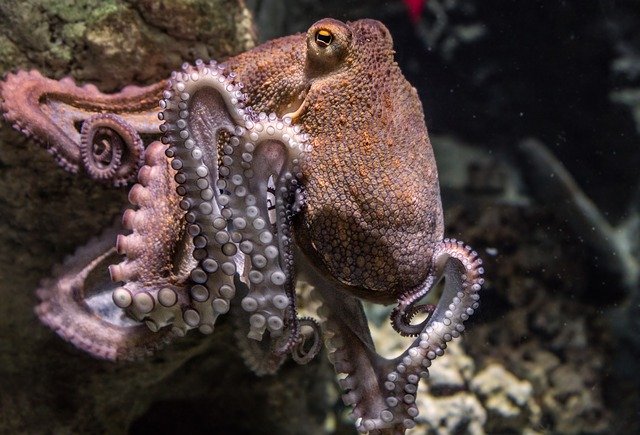
Recently, while watching the PBS Nature documentary Octopus: Making Contact, I found myself reflecting on the remarkable neural evolution of the octopus. What fascinated me was not simply its intelligence, but what appears to be an emerging sense of self.
Consciousness, self-awareness, and self-reflection are often used interchangeably, yet they describe different capacities. Consciousness is the ability to experience and respond to the world. Self-awareness is recognizing oneself as a distinct individual within that world. Self-reflection goes one step further—the capacity to examine one’s own thoughts, choices, and experiences.
The octopus appears to possess extraordinary consciousness and, from what researchers continue to discover, may also demonstrate a meaningful degree of self-awareness. Whether it possesses self-reflection comparable to that of humans remains an open question. Even so, its behavior suggests that evolution has produced, along a path entirely different from our own, a nervous system capable of remarkable individuality.
Because the octopus has no skeleton, much of its nervous system is distributed throughout its body rather than being confined to the brain. As it moves across the ocean floor, it experiences its environment through an intricate network of sensing, exploring, and responding. It sees, touches, tastes, and continually evaluates changing circumstances. It acts not simply as a collection of reflexes, but as an integrated living organism interacting with the world.
Octopuses generally live solitary lives, with few enduring social relationships beyond mating. They grow without parents, siblings, or stable social groups. Their principal relationship is with the environment itself.
Their evolutionary lineage diverged from that of vertebrates roughly 500 million years ago. Yet through an entirely different biological journey, they appear to have arrived at a similar threshold: the emergence of an individual self capable of navigating the world through experience and learning.
This raises a larger question:
Is the emergence of self-awareness merely an evolutionary accident, or is it a natural consequence of increasingly complex neural organization?
If consciousness gradually unfolds through the evolution of living systems, then perhaps what we call God may be understood—not as a matter of belief alone—but as life’s continual movement toward becoming conscious of itself.
I do not offer this as theology, but as a reflection on what seems embedded within the neural biography of life. Across billions of years, living systems have generated ever more intricate relationships. From those relationships arise memory, learning, adaptation, individuality, and, eventually, awareness of oneself.
At some point, a living being must develop an internal representation of itself in order to navigate an increasingly complex web of relationships. Self-awareness becomes not merely an advantage, but a necessity.
Life, however, continually renews itself through birth and death. Each generation inherits what has been learned while adapting to circumstances never before encountered.
This invites another question:
How does life carry forward the successful experiences of its ancestors while remaining open to what is entirely new?
Evolution appears to preserve what proves adaptive while simultaneously creating opportunities for novelty. The neural biography of life is therefore one of continuity and innovation, memory and discovery.
Seen in this light, the history of life on Earth is more than the evolution of species. It is a 500-million-year biography of increasingly complex consciousness, giving rise to richer expressions of self-awareness.
Self-reflection—the ability to consciously examine one’s own experience—may represent the next chapter in that unfolding story. Whether humanity is its culmination or merely another step, we just don’t know at this point.
Perhaps evolution is not simply producing more complex organisms. Perhaps it is gradually enabling life to become ever more deeply aware of itself. What remains to emerge cannot yet be seen. It will require more time for life to continue weaving new neural relationships through which consciousness may discover possibilities that today lie beyond our imagination.
Thanks for your blog, nice to read. Do not stop.
It’s always exciting to know one’s focus resonates with others. Thanks for taking the time and letting us know. Much appreciated.